Loadout
Best Apartment Contingency Kit for Urban Professionals (2026)
December 22, 2025
Quick Navigation — Individual Reviews
- → Sawyer Mini Water Filter ★ 4.3 — $19.97
- → EVERLIT 72-Hour go-bag (2-Person) ★ 4.1 — $59.99
- → Ready America 2-Person Elite Emergency Kit ★ 4.2 — $79.99
- → Sustain Supply Comfort Kit (2-Person) ★ 4.5 — $149.99
Last updated: February 2026 | Reading time: 12 minutes
Most emergency kits are designed for houses with garages, basements, and yards. If you live in an apartment, you already know the problem: there is no room for 55-gallon water barrels, no space for a gas generator, and no yard to run one in safely.
But apartment dwellers face the same risks as everyone else — power outages, severe weather, building evacuations, and disrupted water service. The difference is that your kit needs to be compact, quiet, safe for indoor use, and easy to carry down stairs if you need to evacuate.
This guide covers the best emergency kits and components for apartments in 2026. Every product below was selected for apartment-specific factors: size, weight, noise level, indoor safety, and storage footprint.
What Makes an Apartment Emergency Kit Different
An apartment kit is not just a smaller version of a house kit. The constraints are fundamentally different:
- No gas generators. Carbon monoxide kills in enclosed spaces. You need battery power or nothing.
- Limited storage. Everything needs to fit under a bed, in a closet, or on a shelf — not fill a garage.
- Portability matters. If your building is evacuated, you are carrying your kit down stairs. Weight counts.
- Noise restrictions. Your neighbors are 10 feet away. Anything louder than a conversation is a problem.
- No open flames. Most leases prohibit open flames. Canned heat (Sterno) is the exception in some buildings, but verify your lease first.
- Shared infrastructure. You cannot control when the building restores power or water. You need to be self-sufficient for 72 hours minimum.
With those constraints in mind, here are our picks.
Quick Comparison: Best Emergency Kit Options for Apartments
| Product | Category | Price | Weight | Best For |
|---|---|---|---|---|
| Sustain Supply Comfort Kit (2-Person) | Pre-built kit | ~$250 | ~18 lbs | Best overall pre-built kit |
| Ready America 2-Person Elite Kit | Pre-built kit | ~$250 | ~20 lbs | Most trusted brand (FEMA-aligned) |
| EVERLIT 72-Hour go-bag (2-Person) | Pre-built kit | ~$90 | ~14 lbs | Best budget pre-built kit |
| EcoFlow River 3 | Portable power | ~$200 | 7.8 lbs | Best compact power station |
| Midland ER310 | Emergency radio | ~$40 | 1.3 lbs | Best emergency radio |
| Sawyer Mini Water Filter | Water filtration | ~$25 | 2 oz | Best compact water filter |
Best Pre-Built Emergency Kits for Apartments
Pre-built kits save time and remove guesswork. The trade-off is that some items will be lower quality than what you would choose individually. For most apartment dwellers, a pre-built kit plus a portable power station is the right starting combination.
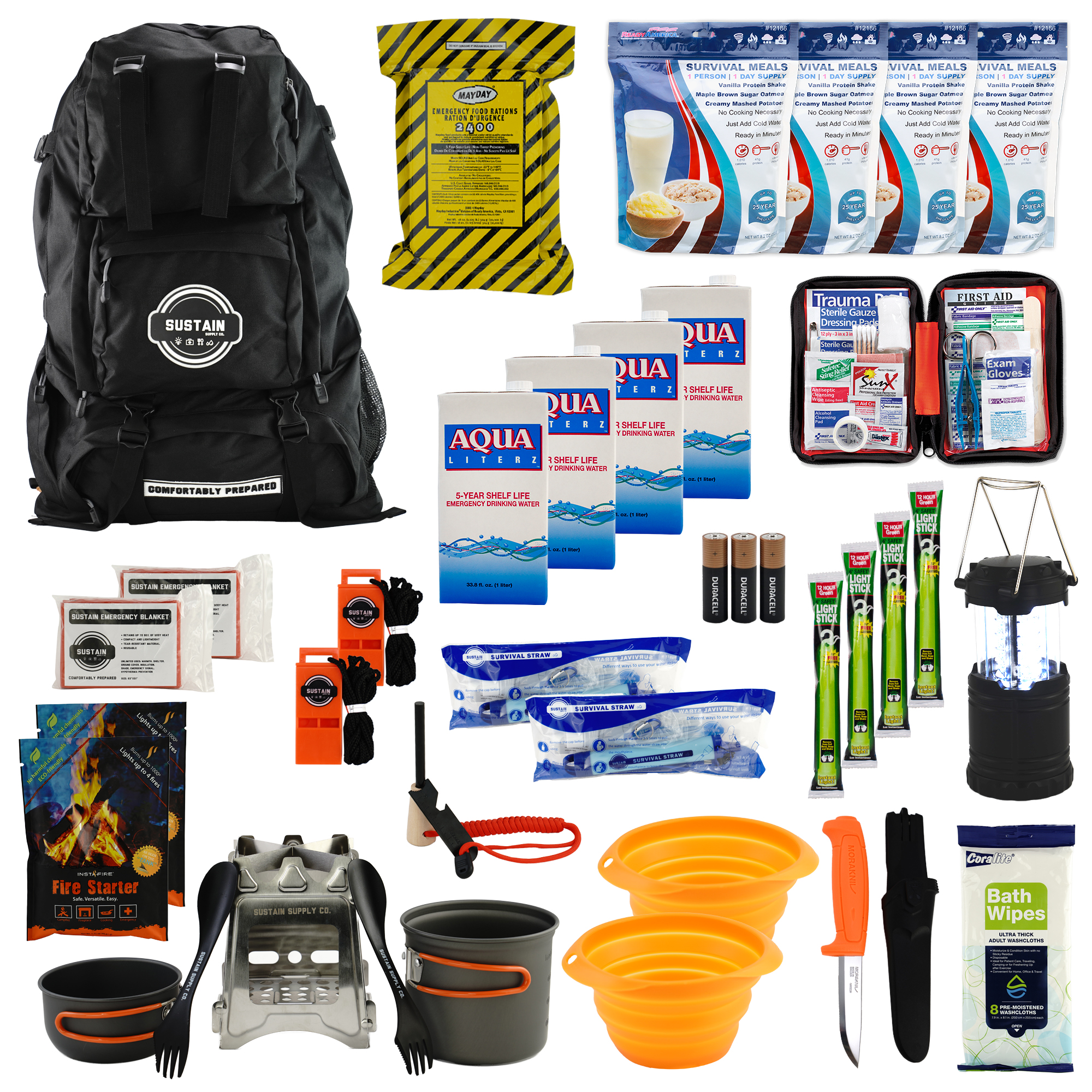
Sustain Supply Comfort Kit (2-Person) — Best Overall
Price: ~$250 | Duration: 72 hours | Weight: ~18 lbs
The Sustain Supply Comfort Kit stands out because it focuses on realistic comfort during an emergency, not just bare survival. It includes food with reasonable taste (a real factor when you are stressed), water pouches, a hand-crank flashlight/radio combo, first aid supplies, hygiene items, and thermal blankets.
For apartments specifically, the Comfort Kit works because it packs into a single backpack that fits on a closet shelf. The food has a 25-year shelf life, so you buy it once and forget about rotation for decades. The included hygiene kit (toothbrush, soap, tissues) addresses a gap most cheaper kits ignore.
What we like: Long shelf life food, backpack format, hygiene items included, reasonable weight for carrying downstairs.
What we do not like: No portable power station included (you will want to add one). The first aid kit is basic — fine for minor issues but not comprehensive.
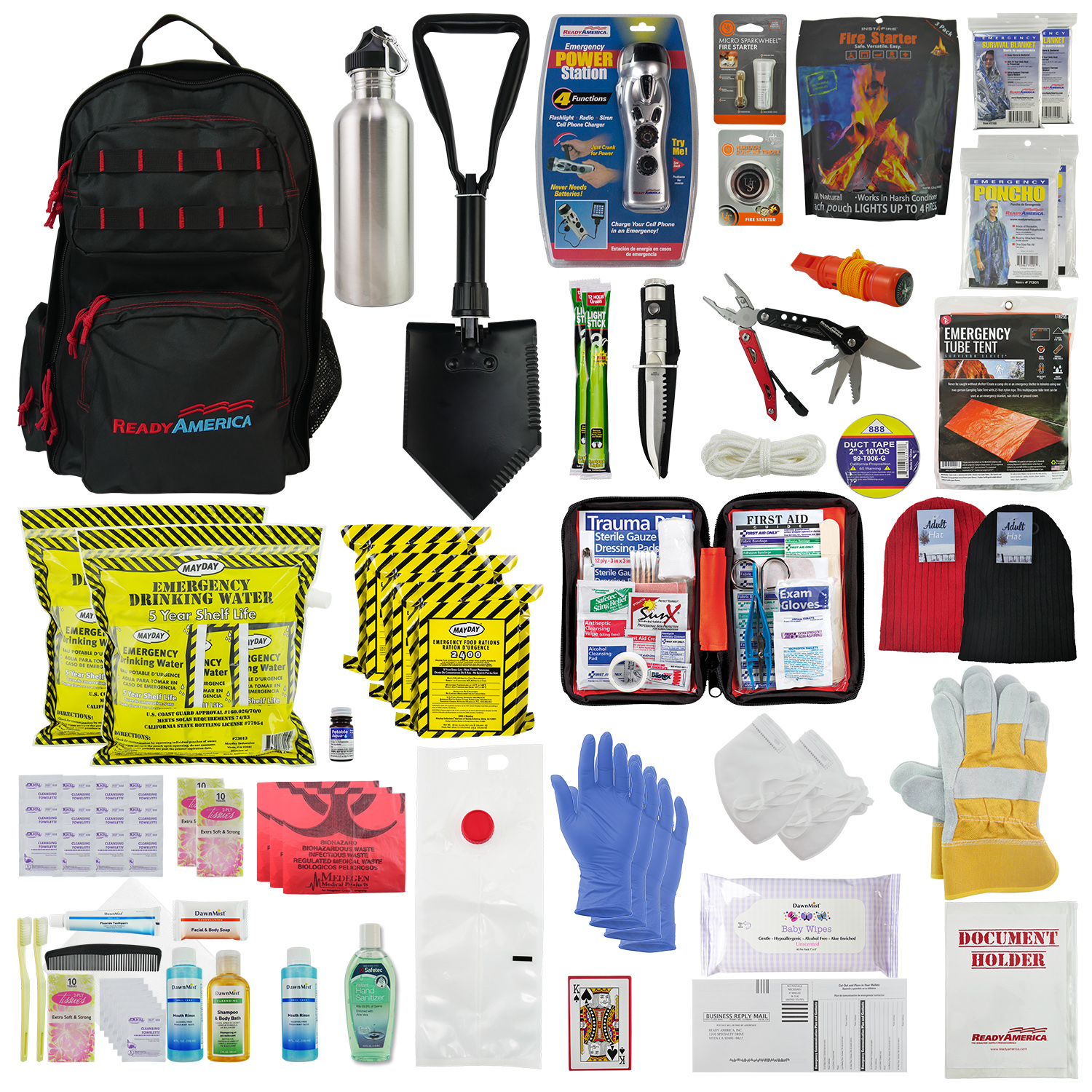
Ready America 2-Person Elite Emergency Kit — Most Trusted
Price: ~$250 | Duration: 72 hours | Weight: ~20 lbs
Ready America has been in the emergency kit business for over two decades. Their Elite kit meets FEMA guidelines and includes food and water (5-year shelf life), emergency blankets, rain ponchos, work gloves, an emergency radio, light sticks, dust masks, and a first aid kit.
The kit is stored in a sturdy backpack and the quality of individual items is consistently solid — nothing flashy, nothing that will fail when you need it. Ready America is the brand most often recommended by emergency management professionals.
What we like: Proven brand, FEMA-aligned contents, good organization inside the backpack, includes PPE (masks, goggles, gloves).
What we do not like: 5-year shelf life on food and water means you need to check and replace every few years. Heavier than the Sustain Supply kit. No power solution included.

EVERLIT 72-Hour go-bag (2-Person) — Best Budget Option
Price: ~$90 | Duration: 72 hours | Weight: ~14 lbs
At roughly a third of the price of premium kits, the EVERLIT provides solid coverage of the basics: food bars, water pouches, first aid supplies, emergency blankets, a flashlight, and basic tools. The backpack is water-resistant and well-organized.
The trade-off for the lower price is that individual item quality is a step below the Sustain Supply and Ready America kits. The food is functional but not pleasant. The tools are lighter duty. But for someone on a tight budget who needs to get from zero preparedness to basic coverage quickly, the EVERLIT is the right call.
What we like: Low price point, lightweight for apartment carry, water-resistant backpack, covers all the basics.
What we do not like: Lower quality individual items, food is purely functional, tools are lighter duty than premium kits.
Essential Add-Ons for Apartment Emergency Kits
No pre-built kit covers everything. These are the components we recommend adding to any apartment emergency kit.
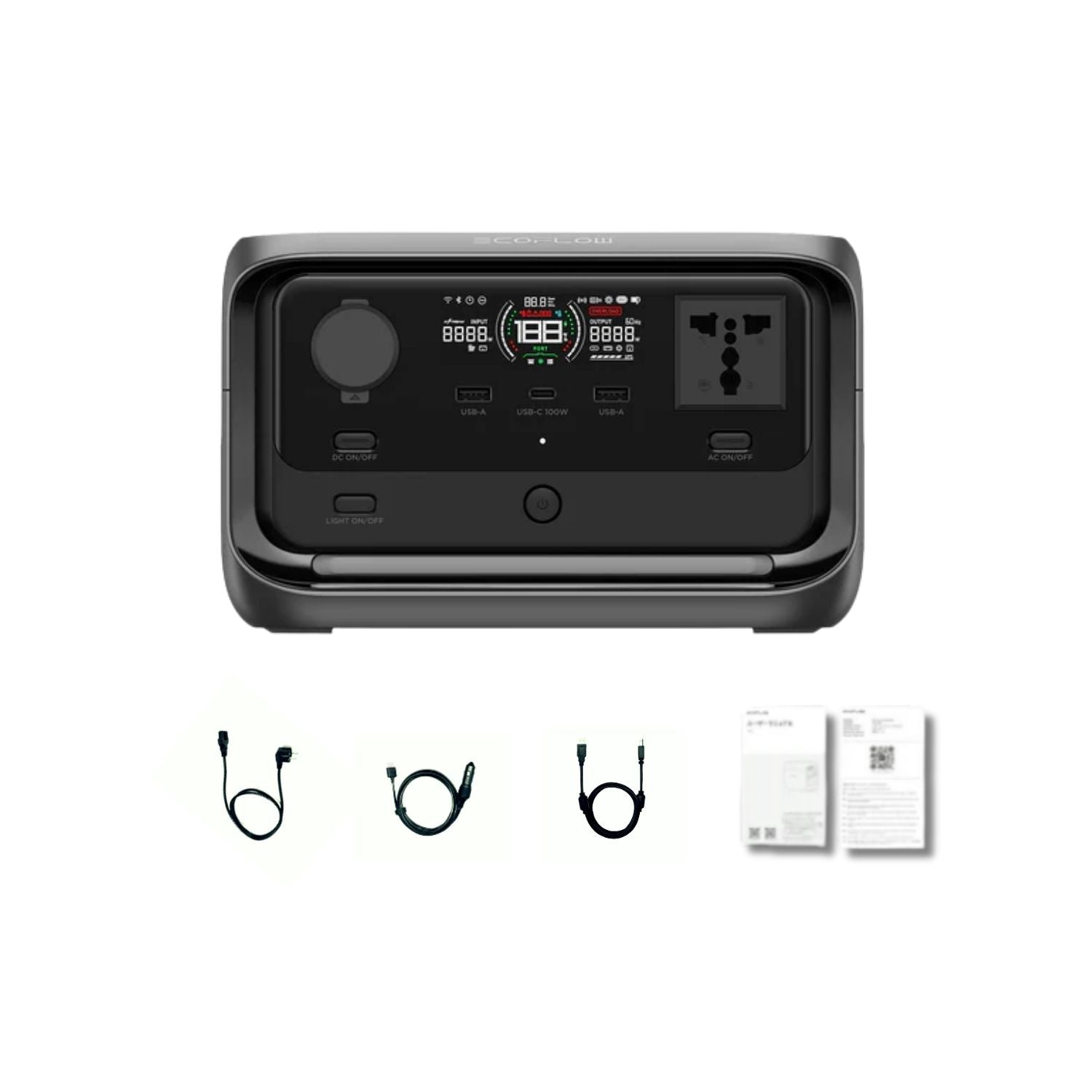
EcoFlow River 3 — Best Compact Power Station for Apartments
Price: ~$200 | Capacity: 245Wh | Weight: 7.8 lbs | Output: 300W
A portable power station is the single most important addition to any apartment emergency kit. When the power goes out, everything depends on it: phone charging, lights, your internet router, and keeping medications at temperature if you have a small cooler.
The EcoFlow River 3 hits the sweet spot for apartments. At 7.8 lbs and roughly the size of a toaster, it stores anywhere and carries easily. The 245Wh capacity charges a phone roughly 20 times, runs LED lights for days, and keeps a laptop going for 4-5 full charges. It recharges from a wall outlet in about an hour.
The key apartment feature is silence. Unlike generators, portable power stations produce zero noise and zero emissions. You can run one in your bedroom at 3am without disturbing anyone.
What we like: Compact size, fast wall recharge, silent operation, LFP battery chemistry (safer indoors, longer lifespan), USB-C output for modern devices.
What we do not like: 245Wh is not enough to run a space heater or full-size fridge. For those, you would need to step up to a 1,000Wh+ unit like the EcoFlow Delta 3 Plus (~$800) or Jackery Explorer 1000 v2 (~$800). But for most apartment essentials — phone, lights, router, laptop — the River 3 is right-sized.
Sizing tip: Add up the wattage of everything you would need to run, multiply by the number of hours, and compare to the station capacity. For example: phone charger (20W) + LED light (10W) + router (15W) = 45W. At 45W continuous draw, the River 3 runs for about 5 hours. For most people, that is plenty to get through a night, and you can recharge once power returns.
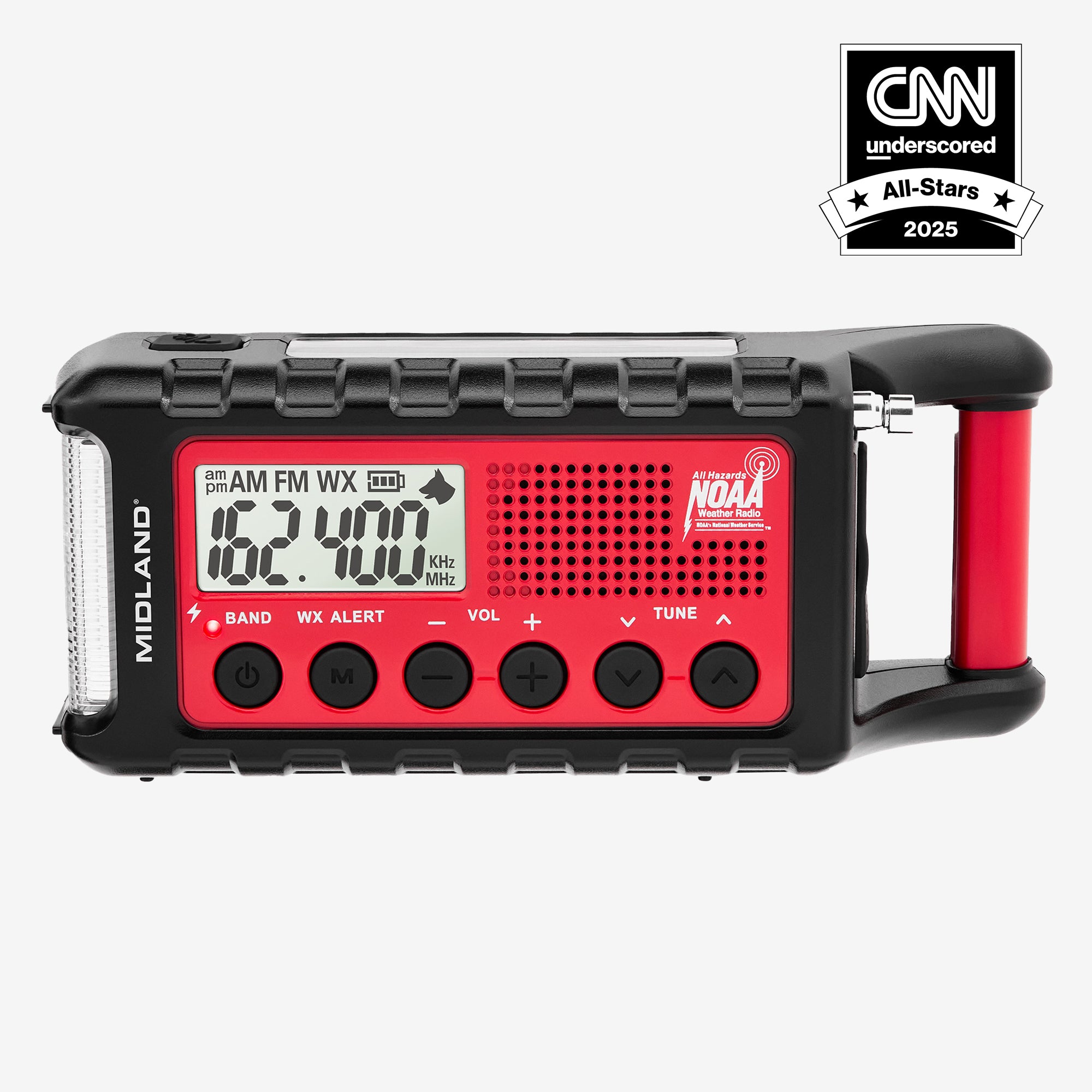
Midland ER310 — Best Emergency Radio
Price: ~$40 | Weight: 1.3 lbs | Power: Hand crank, solar, USB, AAA batteries
When the power is out and cell towers are overwhelmed, NOAA weather radio is often the only source of real-time emergency information. The Midland ER310 receives all seven NOAA weather channels and includes AM/FM. It charges four ways: hand crank, small solar panel, USB, or AAA batteries.
The ER310 also has a built-in flashlight, an SOS strobe, and a USB output that can emergency-charge a phone (slowly). At 1.3 lbs and the size of a paperback book, it takes up almost no space in your kit.
What we like: Four power sources (you will never be without a way to charge it), NOAA weather channels, built-in flashlight, phone charging output.
What we do not like: Phone charging via hand crank is extremely slow — treat it as a last resort, not a primary charging method. The solar panel is tiny and mainly useful for maintenance charging in a window.
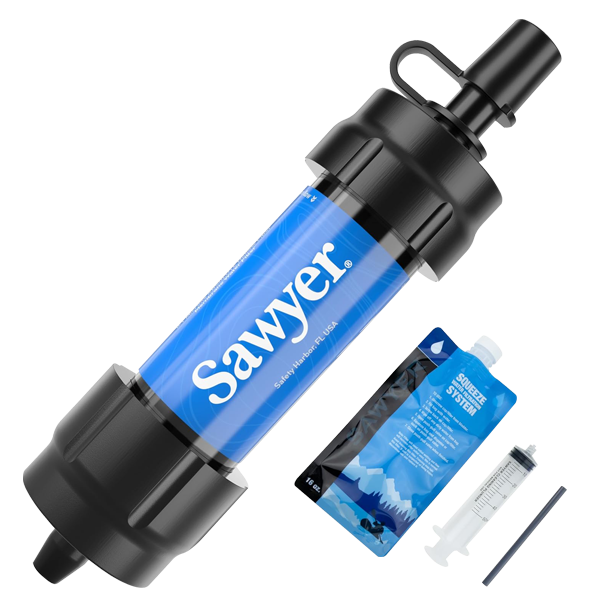
Sawyer Mini Water Filter — Best Compact Water Filtration
Price: ~$25 | Weight: 2 oz | Capacity: Up to 100,000 gallons
If your building loses water pressure, you need a backup plan. The Sawyer Mini filters out 99.99999% of bacteria and 99.9999% of protozoa using a 0.1 micron hollow fiber membrane. It weighs 2 oz and fits in your palm.
In an apartment context, the Sawyer Mini works with any water source — bathtub water you filled before the outage, water from a neighbor, or water from a nearby source if you need to leave the building. It attaches to the included squeeze pouch, screws onto standard water bottles, or connects inline to a hydration pack.
What we like: Negligible size and weight, extremely effective filtration, no replacement filters needed (just backflush to clean), versatile attachment options.
What we do not like: Does not filter viruses (a concern in some developing-country scenarios, but not typical in US municipal water emergencies). Does not remove chemicals or heavy metals. For those concerns, add water purification tablets as a backup.
How to Store an Emergency Kit in a Small Apartment
Storage is the real challenge. Here are the approaches that actually work:
- Under the bed: The average bed has 16 cubic feet underneath. Use bed risers to add more height. A pre-built backpack kit + power station + water containers fit here easily.
- Closet top shelf: The shelf most people waste on old boxes. Perfect for a grab-and-go emergency backpack.
- Behind the couch: A case of water bottles fits behind most couches invisibly.
- Dual-purpose furniture: Ottoman storage cubes, bed frames with drawers, and coffee tables with compartments all work for emergency supplies.
- Collapsible water containers: 5-gallon collapsible jugs take up almost no space when empty. Fill them when a weather warning is issued.
The 10-square-foot rule: A complete 2-week emergency supply for one person fits in about 10 square feet of floor space. That is a 2×5 foot area — smaller than a standard closet. It is less space than most people think.
How to Build a Complete Apartment Emergency Kit
If you prefer to build your own kit rather than buy pre-built, here is what you need. This list is organized by priority — buy in this order if you are building incrementally.
Month 1: The Non-Negotiables
- Water: 1 gallon per person per day, 3-day minimum. Two collapsible 5-gallon containers work well. (~$15-25)
- Light: LED headlamp (hands-free) + LED lantern. Rechargeable preferred. (~$20-40)
- Power: Portable power station (EcoFlow River 3 or similar). (~$200)
- Radio: NOAA weather radio with hand crank (Midland ER310). (~$40)
- First aid: A quality compact first aid kit. (~$30-50)
Month 1 total: ~$305-355
Month 2: Food and Hygiene
- Food: 3-day supply per person. Freeze-dried meals or calorie-dense bars. No-cook options only. (~$30-60)
- Hygiene: Sanitation wipes, trash bags, hand sanitizer, toilet paper. (~$15-20)
- Documents: Copies of IDs, insurance, medications list in a waterproof pouch. (~$10)
- Cash: $200 in small bills. ATMs do not work without power.
Month 2 total: ~$55-90 + $200 cash
Month 3: Depth and Redundancy
- Water filtration: Sawyer Mini + purification tablets. (~$30)
- Warmth: Emergency blankets (Mylar) + warm layers stored with kit. (~$10-20)
- Tools: Multi-tool, duct tape, work gloves, wrench for gas shutoff if applicable. (~$30-50)
- Communication: Whistle, permanent marker (for leaving notes), notebook. (~$5)
Month 3 total: ~$75-105
Total build-your-own cost: ~$435-550 + $200 cash. This gives you a more comprehensive kit than any pre-built option, customized to your apartment and your specific needs.
Do NOT Buy This If
Honest recommendations mean telling you when something is not the right fit:
- You need to run a space heater, full-size fridge, or window AC unit. The compact power stations recommended here (under 300Wh) cannot handle high-draw appliances. You need a 1,000Wh+ unit like the EcoFlow Delta 3 Plus or Jackery Explorer 1000 v2 — expect to spend $600-$900 and store a unit weighing 25-40 lbs.
- You have medical devices that require uninterrupted power (CPAP, oxygen concentrator, nebulizer). These need a power station with UPS (uninterruptible power supply) switchover — typically 10ms or less. The EcoFlow Delta 3 Plus has this feature. A basic power station without UPS will have a gap during switchover that can reset medical devices.
- You live in an area with frequent multi-day outages. A 72-hour kit is a starting point. If your building regularly loses power for 3+ days, you need to invest in a larger power station, more water storage, and a week or more of food. The pre-built kits above are 72-hour solutions.
- You are looking for a tactical or wilderness contingency kit. This guide is for apartment emergencies — power outages, storms, evacuations, water disruption. If you need wilderness contingency gear, this is not the right guide.
Frequently Asked Questions
How much does a basic apartment emergency kit cost?
A pre-built 72-hour kit for two people runs $90-$250 depending on quality. Adding a portable power station ($200) and water filter ($25) brings the total to $315-$475. Building your own kit from individual components costs $435-$550 plus $200 in emergency cash.
Where should I store my emergency kit in a small apartment?
Under the bed is the most common and effective location. A pre-built backpack kit, power station, and collapsible water containers all fit under a standard bed. The closet top shelf is another good option for a grab-and-go bag. Behind a couch works for cases of water.
What size portable power station do I need for an apartment?
For phone charging, lights, a router, and a laptop, a 200-300Wh station (like the EcoFlow River 3) is sufficient for overnight use. For running a small fridge, space heater, or medical equipment, you need 1,000Wh or more. Calculate your needs: list each device wattage, multiply by hours of use, and choose a station with at least 20% more capacity than your total.
Should I buy a pre-built kit or build my own?
If you want to go from zero to prepared quickly, buy a pre-built kit and add a power station. If you want higher-quality components customized to your specific situation, build your own over 2-3 months. Either approach works. The worst option is doing nothing.
Do I need a gas generator for my apartment?
No. Gas generators produce carbon monoxide and cannot be used indoors. They are dangerous in enclosed spaces and prohibited in most apartments. A portable power station is the correct alternative — it is silent, produces zero emissions, and is safe to operate inside your apartment.
The Bottom Line
Apartment contingency planning is not about buying the biggest kit or the most expensive gear. It is about having the right items — compact, quiet, and safe for indoor use — stored where you can reach them when the power goes out at 2am.
Start with a pre-built kit or the Month 1 essentials above. Add a portable power station. Store it under your bed. That single step puts you ahead of the vast majority of apartment dwellers who have no plan at all.
You do not need to prepare for the end of the world. You need to prepare for a bad week.
ISOPREP exists to reduce decision-making under stress. Every product on this page was selected because it solves a specific problem in a specific space constraint. No hype. No fear. Just practical gear that works when you need it.
This article contains affiliate links. If you purchase through our links, we may earn a small commission at no extra cost to you. See our affiliate disclosure for details.
Stay safe out there.
— ISOPREP Team
LUCK: Preparation meets Opportunity.
Get the 72-Hour Emergency Kit Checklist
Free PDF download. No spam. Unsubscribe anytime.